 blog
blog
Best Pet Friendly Flooring for Homes: 2026 Guide
Table of Contents
- Quick Comparison: Best Pet Friendly Flooring for Homes
- Waterproof Luxury Vinyl Plank: The Top Pick for Pet Owners
- Scratch Resistant Flooring for Dogs: Materials That Hold Up
- Pros and Cons of Laminate vs Vinyl for Pets
- Acoustic Impact, Senior Pet Mobility, and Indoor Air Quality
- Installation and Maintenance for Pet-Friendly Floors
- Repairability: What Happens When Accidents Occur
- Frequently Asked Questions
Last Updated: September 21, 2026
Quick Comparison: Best Pet Friendly Flooring for Homes
The best pet friendly flooring for homes comes down to four materials that handle claws, accidents, and heavy traffic. Waterproof luxury vinyl plank (LVP) wins for most pet owners, followed by porcelain tile, then laminate, with engineered hardwood as the premium option for lighter-shedding households.
| Material | Scratch Resistance | Waterproof | Best For | Watch Out For |
|---|---|---|---|---|
| Luxury vinyl plank | High | Yes | Most pet households | Can dent under heavy furniture |
| Porcelain tile | Very high | Yes | Large dogs, accidents | Cold, hard underfoot |
| Laminate | Medium | No | Budget rooms, light pets | Swells if water seeps in |
| Engineered hardwood | Low-medium | No | Senior pets, light traffic | Needs rugs and quick cleanup |
Waterproof Luxury Vinyl Plank: The Top Pick for Pet Owners
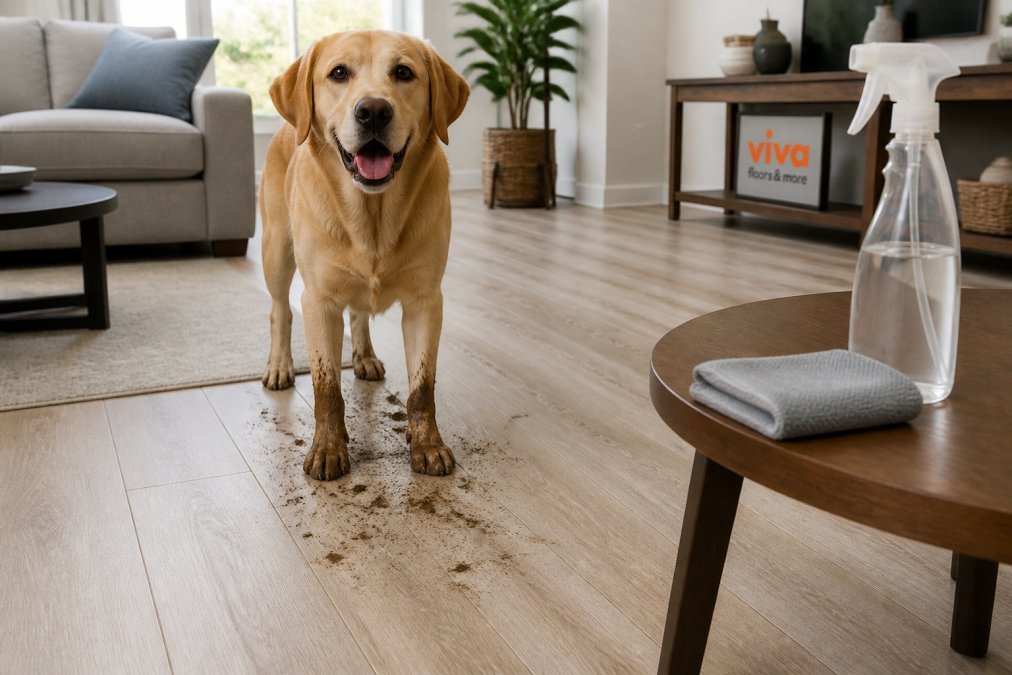
Waterproof luxury vinyl plank is the best all-around choice for pet owners: its core resists moisture completely and its wear layer shrugs off claw marks, so a dog skidding across the room leaves no trail behind.
Wear Layer and Waterproof Core
The wear layer is the clear topcoat that takes abuse; the core keeps water out. For homes with dogs, look for a high-traffic wear layer and a fully waterproof core, not just moisture-resistant.
Scratch Resistant Flooring for Dogs: Materials That Hold Up
Porcelain tile and high-wear luxury vinyl plank are the most scratch resistant flooring for dogs, with tile leading on durability and LVP on comfort. Both resist claw marks far better than wood or standard laminate.
Porcelain Tile and Engineered Hardwood
Porcelain tile is non-porous, so pet accidents and odors don't soak in and cleaning is simple. Engineered hardwood offers real wood looks but needs more care, since standing water and claw marks can damage the surface.
Pros and Cons of Laminate vs Vinyl for Pets
The pros and cons of laminate vs vinyl for pets come down to water. Vinyl is waterproof and forgiving; laminate is not, and one soaked accident can swell the core permanently.
| Factor | Laminate | Vinyl (LVP) |
|---|---|---|
| Water resistance | Low | Waterproof |
| Scratch resistance | Medium | High |
| Repair if damaged | Hard | Plank-by-plank |
| Best for | Dry rooms, light pets | Whole-home pet use |
Acoustic Impact, Senior Pet Mobility, and Indoor Air Quality
Most flooring guides stop at scratch and water resistance. The three factors below are what pet owners actually complain about after move-in, and what big-box guides rarely address.
Noise: Why Hard Floors Amplify Claws
Sound transmission has two parts: impact noise (claws clicking, a dog jumping off the couch) and airborne noise (barking, TV). Hard surfaces like tile, laminate, and glue-down vinyl reflect impact noise into the room below, a 60-pound dog trotting across upstairs tile can sound like a drum solo beneath it.
Senior Pet Mobility and Traction
Older dogs, dogs with arthritis, and dogs recovering from surgery struggle on slick surfaces. The problem is coefficient of friction: polished tile or high-gloss LVP gives paws almost nothing to grip, and a dog that slips once in a hallway often becomes afraid of it.
What actually helps:
- Textured or embossed surfaces. A registered emboss (the texture follows the wood grain) grips better than a smooth finish. Matte and low-sheen surfaces outperform high-gloss every time.
- Area rugs and runners. The cheapest, fastest fix. Put a runner down the main traffic path and a rug at the bottom of stairs. Use a non-slip pad underneath so the rug itself doesn't slide.
- Stair treads. Bare hardwood or tile stairs are the single most dangerous surface for a senior dog. Carpet runners or adhesive tread strips make stairs navigable again.
- Ramps over steps. For dogs that can no longer do stairs at all, a low-angle ramp to the couch or bed removes the jump entirely.
Indoor Air Quality and VOCs
New flooring can release volatile organic compounds (VOCs) from adhesives, finishes, and the core itself. The smell of a freshly installed floor is largely off-gassing, lingering for days to weeks depending on ventilation and product chemistry.
What to look for:
- Low-VOC or zero-VOC adhesives. Glue-down installations use the most adhesive, so this matters most there. Ask the installer what adhesive they plan to use and whether a low-VOC alternative is available.
- FloorScore and GREENGUARD certifications. These are third-party programs that test flooring and adhesives for VOC emissions. A product carrying either has been independently verified, which is more meaningful than a manufacturer's own "low-VOC" claim.
- Solid vs. engineered vs. synthetic. Solid hardwood and tile have minimal off-gassing once installed. Engineered wood, laminate, and vinyl rely on binders and wear layers that can emit for a period after installation.
- Ventilation during and after install. Open windows, run fans, and if possible keep pets out of the room for the first 24 to 72 hours. The EPA's resources on volatile organic compounds explain what VOCs are and why indoor concentrations can exceed outdoor levels.
Installation and Maintenance for Pet-Friendly Floors
Daily maintenance is simple: sweep or vacuum to lift grit, then damp-mop with a pet-safe cleaner. Grit is the enemy, trapped sand acts like sandpaper under paws and dulls the surface finish.
Here's a maintenance schedule that works:
- Sweep or vacuum high-traffic areas daily
- Damp-mop with a pH-neutral, pet-safe cleaner weekly
- Wipe accidents immediately, even on waterproof floors
- Trim pet nails every few weeks to reduce scratching
- Place mats at doors and water bowls
- Inspect seams and edges monthly for lifted planks
Repairability: What Happens When Accidents Occur
Durability tells you how long a floor lasts; repairability tells you what happens on the day it doesn't. For pet owners, this separates a floor you live with for 15 years from one you resent for 10.
How Each Material Actually Repairs
Luxury vinyl plank (floating install). The most repairable pet floor: floating LVP clicks together at the edges, so one damaged plank can be removed and replaced without disturbing the rest. Score and cut out the center of the damaged plank, pry the pieces free, trim the locking tabs off the replacement, and glue it into the gap. A pro can do this in under an hour.
The Spare-Box Rule
Dye lots change. A plank bought three years from now won't match today's floor, even with an identical SKU, and manufacturers discontinue colors without warning. The rule: buy 5 to 10 percent extra square footage at install and store it flat in a climate-controlled space. For a 500-square-foot room, that's roughly one to two extra boxes, the cheapest insurance you'll ever buy on a floor.
When to Repair vs. Replace
- One or two damaged planks in a floating LVP floor. Repair. This is exactly what the material is designed for.
- A swollen laminate plank. Replace the affected area. There is no repair.
- A cracked tile in a high-traffic spot. Repair, and keep spares for the next one.
- Widespread water damage across a room. Replace the affected section. Trying to salvage individual planks in a saturated floor usually fails.
- Surface scratches only. Often refinishable or concealable with a color-matched filler pen, depending on material.
Pet owners often discover the repairability question only after the first accident, when the spare boxes are gone and the color is discontinued. Ask about repair method and spare availability before you buy, not after.
Frequently Asked Questions
What type of flooring is most pet-resistant?
Waterproof luxury vinyl plank (LVP) and porcelain tile are the most pet-resistant options. LVP handles pet accidents, claw marks, and high-traffic areas when it has a wear layer of 20 mil or higher. Porcelain tile is nearly scratch-proof and completely waterproof. Both are non-porous, so they resist stains and odors. For homes with dogs and cats, LVP offers the best balance of durability, comfort, and realistic wood looks.
Is LVP or laminate better with dogs?
LVP is generally better with dogs because its core is waterproof, while most laminate cores are moisture-resistant but not waterproof. Dog pee can seep into laminate seams and cause swelling. LVP also tends to be softer underfoot and quieter. Laminate can work in low-moisture areas and often costs less, but for homes with puppies or senior dogs prone to accidents, waterproof LVP is the safer long-term choice.
Will dog pee ruin vinyl plank flooring?
No, waterproof luxury vinyl plank will not be ruined by dog pee if it is cleaned up within a reasonable time. The waterproof core prevents moisture from reaching the subfloor. However, urine can discolor the surface if left for days, and it may seep into seams if the planks are not tightly locked. Wipe accidents promptly with an enzymatic cleaner to protect the wear layer and keep odors from setting in.
How do I choose flooring that won't scratch from pet claws?
Look for a scratch-resistant flooring with a hard surface finish, such as a polyurethane coating with aluminum oxide or a ceramic bead topcoat. For LVP, choose a wear layer of at least 20 mil. Porcelain tile with a matte or textured finish also resists claw marks. Avoid soft woods like pine and high-gloss finishes that show every scratch. Ask for samples and test them with a key or coin before buying.