 ultimate-guide
Choosing Flooring for Humid South Texas: 2026 Guide
Table of Contents
- Why Humid South Texas Demands a Different Approach to Flooring
- Waterproof Flooring Options That Handle South Texas Humidity
- Moisture Barrier Requirements for Flooring on Concrete Slabs
- The Acclimation Process for Hardwood Floors in Humid Climates
- Best Flooring for Wet Areas: Kitchens, Bathrooms, and Laundry Rooms
- Indoor Air Quality and VOCs: What Humid Climates Change
- Warranty Implications and Long-Term Maintenance for Humid Climates
- Frequently Asked Questions
Last Updated: September 28, 2026
Why Humid South Texas Demands a Different Approach to Flooring
Choosing flooring for humid south Texas starts with one uncomfortable fact: the climate, not the showroom, decides whether your floor survives. Relative humidity here swings hard, and most homes sit on concrete slabs that wick moisture upward year-round. This guide covers the materials that hold up, the moisture barrier requirements that protect them, and the acclimation process most installers skip.
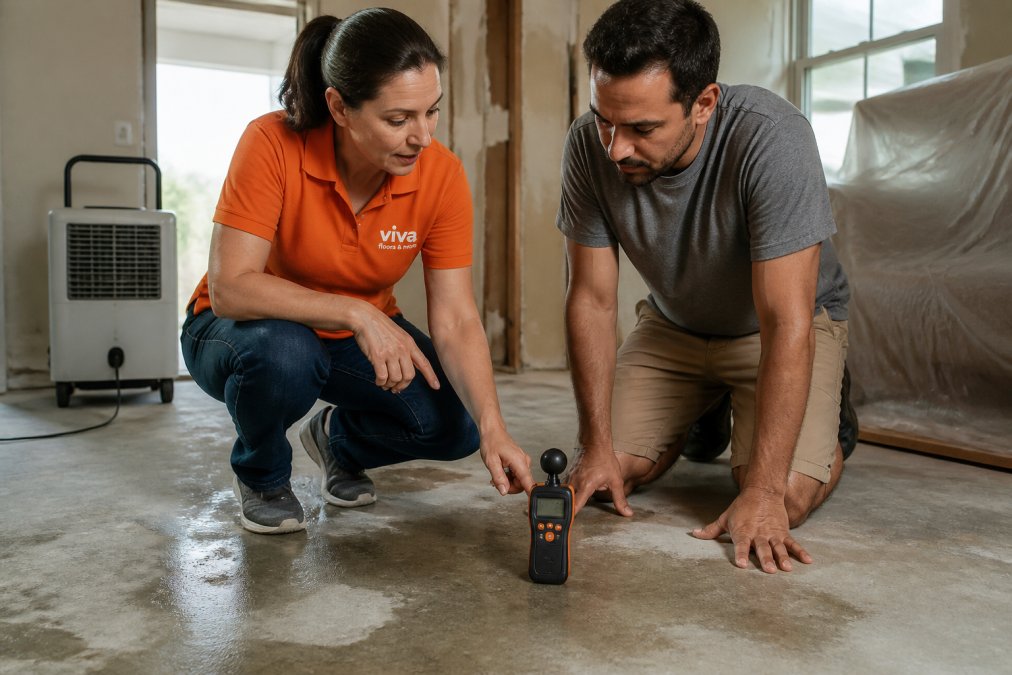
The problem is rarely the plank. It is almost always the substrate underneath it.
Concrete is porous. It pulls moisture from the soil and releases it as vapor, a process called moisture vapor transmission. When that vapor hits an organic floor covering, the material absorbs it, swells, and eventually cups or buckles. Solid hardwood has no defense against this. Neither does standard laminate.
Waterproof Flooring Options That Handle South Texas Humidity
Waterproof flooring options fall into three practical categories for this climate: rigid-core vinyl, porcelain tile, and engineered hardwood. Each handles humidity differently, and the right pick depends on the room, the slab, and how much you care about resale.
Luxury Vinyl Plank (LVP) and Rigid Core
Luxury vinyl plank is the most forgiving choice for a humid climate. The waterproof core resists swelling, and the wear layer determines how long the surface holds up under dogs, kids, and foot traffic. A thicker wear layer means better scratch resistance, which matters in high-traffic areas.
The catch: LVP still needs a flat, dry slab. A waterproof plank over a wet substrate traps moisture and grows mold underneath.
Porcelain and Ceramic Tile
Porcelain tile is the most dimensionally stable option available. It does not absorb water, does not swell, and does not care about humidity swings. Ceramic behaves similarly but is softer and more porous, so it suits walls and low-traffic floors better than a busy kitchen.
Grout is the weak point.
Engineered Hardwood vs. Solid Hardwood
Engineered hardwood is built from cross-layered plywood with a real wood veneer on top. That layered construction resists the thermal expansion and humidity-driven movement that makes solid hardwood risky on a slab. Solid hardwood is a single piece of milled wood. It moves with every humidity change, and on concrete it almost always loses.
Moisture Barrier Requirements for Flooring on Concrete Slabs
Moisture barrier requirements exist because concrete slabs never stop emitting vapor. A vapor barrier is a membrane installed between the slab and the flooring that blocks that vapor from reaching the material above. Without one, even waterproof flooring can fail when hydrostatic pressure pushes moisture up through the slab.
Testing Your Subfloor Before Installation
Test before you buy, not after. There are two accepted methods, and they measure different things.
Reading the Numbers Before You Choose a Barrier
Once you have a reading, the barrier decision follows a simple logic:
- Low emission. A standard underlayment with a built-in vapor retarder is often enough, provided the manufacturer's spec sheet allows it.
- Moderate emission. A dedicated vapor barrier membrane with a low permeance rating is required. Permeance is measured in perms; lower is better. Most flooring manufacturers specify a maximum permeance in their installation documents.
- High emission or active hydrostatic pressure. A surface membrane alone may not hold. You need a high-performance epoxy or polyurethane moisture-mitigation system, and sometimes a self-leveling subfloor prep layer, before any barrier goes down.
Vapor Barriers and Hydrostatic Pressure
Hydrostatic pressure is groundwater pushing upward against the slab. It is common in low-lying areas and after heavy rain. Where pressure is high, a standard underlayment will not hold. You need a high-performance vapor barrier with a low permeance rating, and sometimes a subfloor prep layer to level the slab first.
The Acclimation Process for Hardwood Floors in Humid Climates
The acclimation process for hardwood floors means letting the material sit in the room where it will be installed long enough to reach moisture equilibrium with that space. Skip it, and the planks will expand or contract after installation, opening seams and cupping edges.
Here is how to do it right:
- Place boxes in the installation room, not the garage
- Run the home's HVAC at normal living conditions
- Leave the flooring to sit for the manufacturer's stated period, often several days
- Check the moisture content of the wood against the subfloor reading
- Only install once the two readings are close
Best Flooring for Wet Areas: Kitchens, Bathrooms, and Laundry Rooms
The best flooring for wet areas is porcelain tile or rigid-core vinyl. Both shrug off standing water and handle the humidity that kitchens and bathrooms generate daily. Water resistance is the deciding factor, not style.
| Room | Best Material | Why It Works | Watch For |
|---|---|---|---|
| Kitchen | Porcelain tile | Handles spills and heavy traffic | Grout sealing |
| Bathroom | Porcelain or ceramic tile | Waterproof surface | Subfloor prep |
| Laundry room | Rigid-core vinyl | Waterproof, easy to replace | Seam integrity |
| Living areas | Engineered hardwood | Stable in humidity swings | Acclimation period |
Indoor Air Quality and VOCs: What Humid Climates Change
Indoor air quality is where humid climates change the flooring conversation. Heat and moisture accelerate the release of volatile organic compounds, or VOCs, from adhesives, finishes, and some synthetic materials. A floor that smells fine in a dry climate can off-gas more in a warm, humid home.
Warranty Implications and Long-Term Maintenance for Humid Climates
Warranty coverage often hinges on installation conditions, not just the product. Many manufacturers require documented moisture testing and a compliant vapor barrier. Install over a wet slab without that paperwork, and a claim for swelling and warping can be denied outright.
What Manufacturers Actually Ask For
When a claim is filed, the paperwork request usually includes:
- The moisture test results from before installation, with the method and date
- Proof of the vapor barrier product and its permeance rating
- The acclimation record for wood and engineered products
- Evidence that indoor humidity was maintained within the warranty range
- Proof of professional installation, if the warranty requires it
Long-Term Maintenance Comes Down to Controlling the Indoor Climate
- Keep indoor relative humidity in a moderate range with a dehumidifier or HVAC. In a humid climate, a standalone dehumidifier in the main living area is often the difference between a floor that lasts and one that does not.
- Wipe up standing water promptly, especially near seams and at the base of appliances.
- Reseal grout in wet areas on a regular schedule, annually is a reasonable baseline in a humid home.
- Recheck moisture readings if you notice buckling, cupping, or a musty smell. Those are early signals, not cosmetic issues.
- Keep HVAC running during vacations. A closed-up house with no air movement is the fastest way to void a warranty and ruin a floor at the same time.
A hygrometer costs very little and tells you more about your floor's future than any showroom display. Pair it with a dehumidifier sized to the square footage of the home, and you have addressed the two variables, moisture vapor from below and ambient humidity from above, that decide whether the floor survives.
Frequently Asked Questions
What is the best flooring for a hot, humid climate like South Texas?
Luxury vinyl plank (LVP) and porcelain tile perform best in humid South Texas. LVP has a waterproof core that resists swelling and warping, while porcelain tile is naturally water-resistant and won't grow mold. Engineered hardwood also works if installed with proper moisture barriers. Avoid solid hardwood and standard laminate, which expand and cup when relative humidity stays above 60%.
Do I need a moisture barrier for my flooring installation?
Yes, if you're installing over a concrete slab, which is common in South Texas homes. Concrete allows moisture vapor transmission even when it looks dry. A vapor barrier with a perm rating of 0.1 or lower prevents moisture from reaching your flooring. Always test your slab first using a calcium chloride test or hygrometer to confirm moisture levels are safe before installation.
How does high humidity affect hardwood flooring?
High humidity causes solid hardwood to absorb moisture, leading to swelling, warping, and cupping. Engineered hardwood handles humidity better because its plywood core adds dimensional stability. The acclimation process for hardwood floors, letting planks sit in the room for 3-5 days before installation, helps them adjust to your home's moisture level and reduces movement after installation.
What are the signs of moisture damage in flooring?
Watch for buckling, cupping, or crowning in plank flooring, gaps between boards, soft spots underfoot, and discoloration near seams. Musty odors indicate mold growth beneath the surface. In tile, loose or cracked tiles and crumbling grout signal moisture issues. If you notice any of these signs, check your indoor relative humidity and inspect your vapor barrier immediately.
Flooring failure in a humid climate is almost never a mystery. It is a moisture test that never happened, a vapor barrier that was skipped, or an acclimation period that got rushed. Viva Floors & More takes the guesswork out of that process with expert consultation, a vast in-stock selection, and guidance for both DIY installers and contractors managing full builds. Request an estimate and get a floor that is matched to your home's actual moisture profile, not a showroom sample.