
 comparison
Flooring Samples vs Installed Look: Why the Difference?
Table of Contents
- Why Flooring Samples vs the Installed Look Rarely Match
- Showroom Lighting vs Natural Light: What Changes on Site
- Flooring Color Variation in Natural Light and Through the Day
- The Best Way to View Flooring Samples Before You Commit
- How to Choose Flooring for Open Floorplans
- Common Mistakes That Make Samples Look Wrong After Installation
- Frequently Asked Questions
Last Updated: September 30, 2026
Why Flooring Samples vs the Installed Look Rarely Match
Flooring samples vs the installed look rarely match because a small sample viewed under showroom lighting tells you almost nothing about how a full floor will read in your home. The lighting is different, the scale is different, and the sample itself may come from a different production batch than the flooring you eventually install.
At Viva Floors & More, we've watched this scenario play out: a homeowner picks a beautiful plank in the showroom, orders the full floor, and then calls us confused when the installed result looks nothing like what they expected.
Here's the good news. The mismatch is predictable, and once you understand why it happens, you can test for it before you commit.
A flooring sample is a small cut of a larger production run, typically measuring a few inches wide and a foot or two long. That size works for checking color and finish, but it fails at showing you pattern repeat, batch consistency, or how dozens of planks will look together across a whole room.
Showroom Lighting vs Natural Light: What Changes on Site
Showroom lighting and natural light produce different color results from the same flooring plank. Showrooms rely on overhead fixtures that stay constant. Your home gets a moving mix of daylight, ambient light, and artificial light that shifts hour by hour.
Color Rendering and Lighting Temperature
Color rendering is how accurately a light source shows the true colors of a surface. Standard showroom fixtures often have a color rendering index below what you'd get from direct sunlight or a well-chosen LED.
Lighting temperature measures how warm or cool a light source appears, rated in Kelvin. A 2700K bulb casts a warm, yellow tone. A 5000K fixture runs cool and blue. The same oak plank can look honey-toned under one and grayish under the other.
This effect has a name: metamerism. It's when two colors match under one light source but look different under another. Flooring is especially prone to it because wood and laminate surfaces have complex undertones.
How Ambient Light Shifts Flooring Color Perception
Ambient light is the indirect light bouncing off walls, ceilings, and furniture. A room with warm beige walls bounces warm light onto your floor. A room with cool gray walls does the opposite.
This is why the same flooring material can look completely different in two homes on the same street. The floor didn't change. The light around it did.
U.S. Department of Energy guide to lighting and color rendering
Flooring Color Variation in Natural Light and Through the Day
Flooring color variation in natural light changes throughout the day, and that's normal. Morning sun runs cooler and more direct. Afternoon light warms up. Evening artificial light adds its own cast on top.
Wood grain and vinyl plank surfaces react to all of it. Direct sun can make a medium-brown hardwood read almost golden. The same plank in shade can look flat and dark.
North-facing rooms tend to receive cooler, more consistent light all day. South-facing rooms get strong direct sun that shifts dramatically from morning to evening. If you're choosing flooring for a north-facing living room, a warm undertone often helps balance the cool light.
Don't judge a sample from a single viewing. Check it in the morning, at midday, and after sunset. The floor you live with is the one you see at all three times.
The Best Way to View Flooring Samples Before You Commit
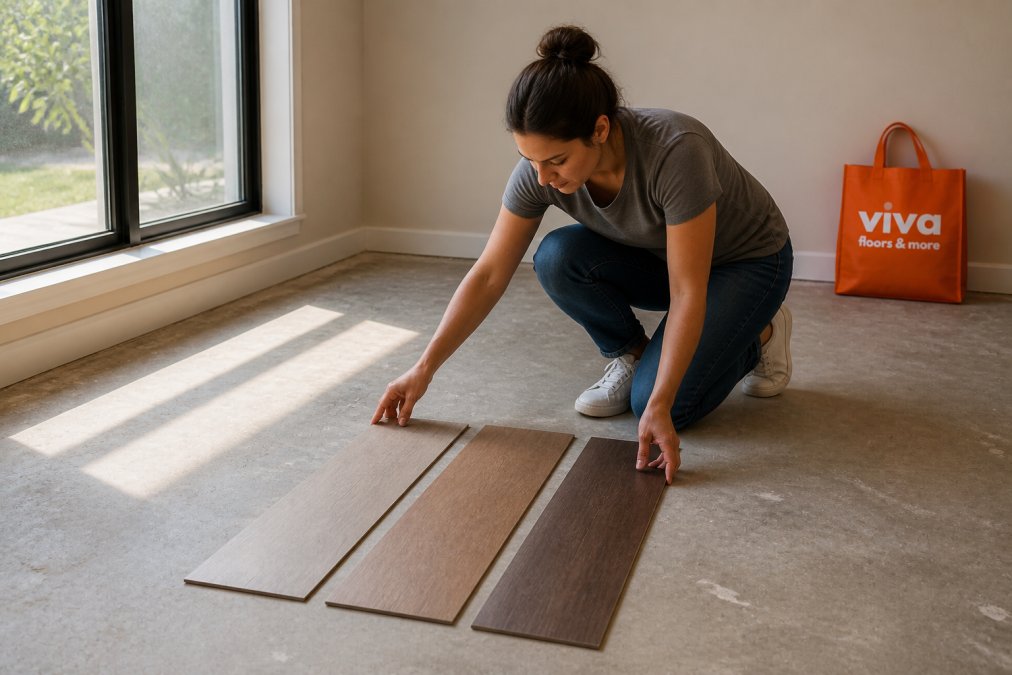
The best way to view flooring samples is to test them in your own home, under your own lighting, at full scale, and against the exact batch you plan to install. Showroom viewing is a starting point, not a final answer.
In-Home Testing and Sample Size
Request full-size planks or larger sample boards whenever possible. A small square chip hides pattern repeat and grain flow. A full plank shows you what a real installation will look like.
Lay samples flat on the subfloor in the actual room. Move them around. Check them against your wall color and near your cabinets. This is the single most effective step you can take.
Why sample size matters more than most people realize. A 6-inch chip shows roughly one plank face. A 500-square-foot room with 7-inch-wide planks contains dozens of plank faces laid side by side. Pattern repeat, the distance before a printed or embossed design starts over, is invisible on a chip but obvious across a full floor. Laminate and vinyl plank (LVP) are printed in repeating cycles, often every few planks. On a small sample you see one tile of that cycle.
Digital Visualization Tools and Batch Consistency
Digital visualization tools let you upload a photo of your room and drop in flooring options. They're useful for narrowing choices, but they can't replicate real light behavior or true texture. Treat them as a shortlist tool, not a decision-maker.
Professional Lighting Calibration at Home
You don't need a designer's toolkit to judge a sample accurately, you need to remove variables. Showrooms often use high-CRI fixtures in the 3000K-3500K range, which is warmer than midday daylight and cooler than a typical 2700K living room bulb. That single difference can flip a gray-brown plank toward brown or gray.
To simulate a neutral reference at home:
- Test under a 5000K, high-CRI (90+) bulb. This approximates north-facing daylight and is the closest thing to a neutral baseline. Compare the plank under this light first.
- Then test under your actual room lighting. Whatever you have installed, 2700K, 3000K, dimmable, or mixed, is the light you'll live with. The neutral test tells you the true color; the room test tells you the lived color.
- Test against your wall and cabinet colors. Undertones interact. A warm beige wall pushes a floor warmer; a cool gray wall pushes it cooler. Hold the sample vertically against the wall, not just flat on the floor.
- Test at three times of day. Morning, midday, and after sunset. The floor you live with is the one you see at all three times.
How to Choose Flooring for Open Floorplans
Here's a practical way to evaluate options:
| Consideration | What to Check | Why It Matters |
|---|---|---|
| Lighting zones | Sample in each connected area | Light varies room to room |
| Cabinet contrast | Compare floor against cabinetry | Contrast changes perceived tone |
| Wall color | View floor beside wall paint | Undertones interact |
| Sheen level | Check gloss under direct sun | Gloss shows glare and dust |
| Pattern repeat | Lay multiple planks together | Reveals repetition |
| Square footage | Estimate total visible area | Scale amplifies tone and pattern |
| Transitions | Identify doorways and thresholds | Breaks in the floor change how it reads |
If your open plan has more than one flooring material, order samples of both and view them together at the seam. The decision isn't whether each floor looks good on its own; it's whether they look good next to each other.
Common Mistakes That Make Samples Look Wrong After Installation
Most sample-to-installation mismatches trace back to a handful of avoidable errors. Here's what to watch for.
- Judging under showroom light only. Test in your home before ordering.
- Using a tiny sample. Small chips hide pattern and grain flow.
- Mixing batches. Order the full project quantity at once.
- Ignoring wall and cabinet color. Contrast shifts perceived tone.
- Skipping time-of-day testing. Check morning, afternoon, and evening.
- Overlooking sheen. Gloss level changes how color reads in sunlight.
Frequently Asked Questions
Why does flooring look different once it is installed?
Several factors combine. Showroom lighting temperature and color rendering shift how a sample reads compared to daylight in your home. A small sample only shows a fraction of the pattern repeat, so wood grain and color variation spread across a full room look different. Batch consistency also matters: planks from a different production run can carry slightly different undertones. Together these make the installed floor look darker, warmer, or more varied than the sample you carried home.
How can I accurately test flooring samples in my home?
Take the sample to the actual room, not the garage or a hallway. Lay it on the subfloor near a window and leave it for 24 to 48 hours. Check it in morning light, midday sun, and after dark with your interior lights on. Look at it against your wall color and next to a cabinet door. Ask for the largest sample available, ideally several planks, so you can see how the pattern repeat and color variation play out across a wider area.
Does natural light change the appearance of flooring?
Yes, and more than most people expect. Flooring color variation in natural light depends on the direction your windows face, the time of day, and how much ambient light bounces off walls and furniture. North-facing rooms stay cooler and can make warm undertones look gray. South-facing rooms flood with direct sun that brightens and warms the floor. A sample viewed under showroom lights at noon may look nothing like the same plank at 7 p.m. in your living room.
Should I order large flooring samples before committing?
Larger samples are worth the effort. A small swatch hides pattern repeat, plank-to-plank color variation, and how the wood grain reads across a full-room view. Ask for three or four full planks from the same batch, then lay them together the way they would install. This reveals batch consistency and lets you judge texture, finish, and sheen at the same time.